What is diminished value?
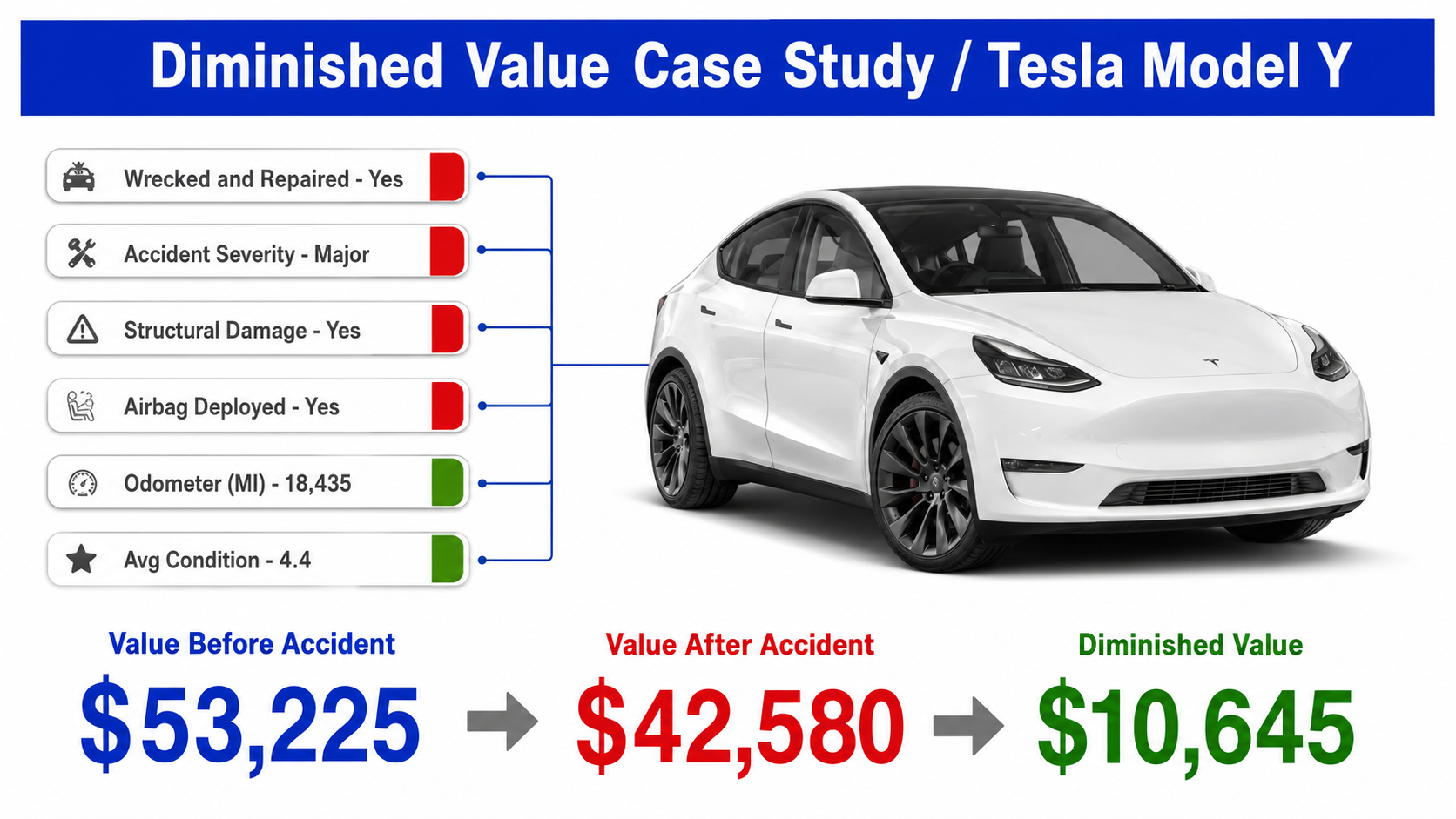
Diminished value is the difference between your car's fair market value before the accident and its value after — even when it has been repaired to the highest standard. It is a real, documented financial loss, not a hypothetical.
Two identical vehicles — same year, same mileage, same condition — will not sell for the same price if one has a collision on its history report. Buyers and dealers pay less for a car with an accident on record, every time. That gap is yours to recover.
Why your repaired car is still worth less
Several factors drive the size of a diminished value loss:
- Severity of the accident — structural or airbag damage hurts value far more than a bumper scuff.
- Age & condition — newer, well-kept vehicles lose more in absolute dollars.
- Demand for your make & model — desirable vehicles have further to fall.
- Quality and type of repairs — aftermarket parts and poor repairs deepen the loss.
A real recovered case
Do you qualify?
You likely have a strong diminished value claim if you were not at fault, your vehicle is worth more than $5,000, the damage exceeded a few hundred dollars, your car isn't ancient or salvage-titled, and the accident was inside your state's filing window. Specific rules vary state by state — the tool above shows yours.
A claim is generally not available if you were at fault, the car has a branded/salvage title, it was declared a total loss, or the statute of limitations has lapsed.
The fastest way to know: submit a free claim review and we'll tell you on the spot.